Pick one AI vendor early and you often discover the costs, the blind spots, and the lock in factor only after your application depends on them. That is a bad idea for research tooling.
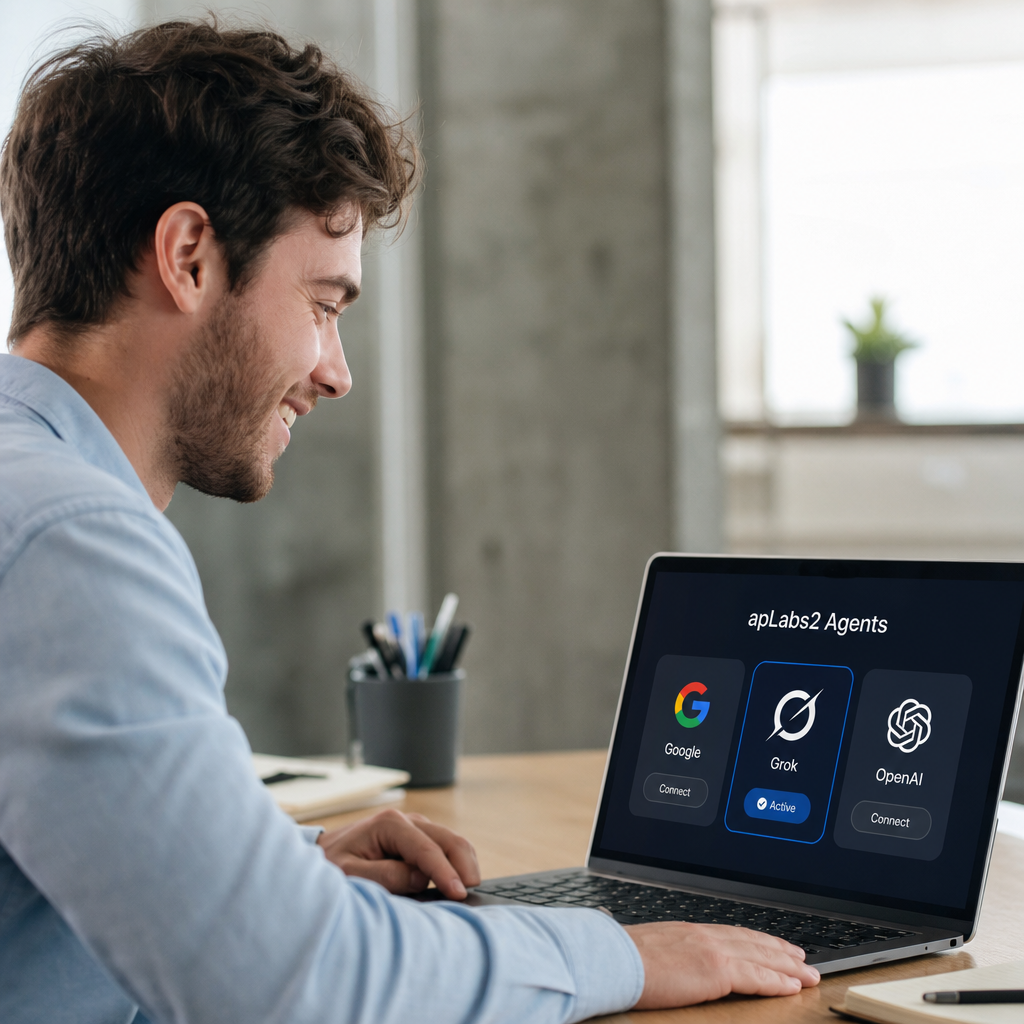
I added SpaceXAI’s Grok as a model provider in apLabs today for simple, practical reasons.
Why Grok landed on the list
Grok is good at reporting breaking news, live events, and sentiment from X. For research work, that is useful signal you do not always get cleanly elsewhere. Trying to get authentic signals of what people are contributing on a platform like LinkedIn can be an exercise in utter futility. I don’t want only sanitised corporate polish and press releases, I want to listen to real people and hear their real unbounded opinions and stories.
Having blown my budget two months in a row, I am also watching token costs rising. OpenAI’s API pricing is starting to sting, and model pricing now shapes which model I reach for, frontier or not.
The integration of Grok into apLabs was straightforward once Claude Code had my new requirements. Grok’s API is close enough to OpenAI’s that wiring it into Semantic Kernel was quick and painless. (Semantic Kernel is the orchestration layer that sits between the app and the models: prompts, tools, responses). I wanted native search from Grok itself. Semantic Kernel does not support that path cleanly, so Claude and I (!) built a separate tool that calls the endpoint directly and adds to the growing list of tools registered in SK. apLabs can now run both Google search and xAI search in the same research flow which I think is pretty impressive, and useful.
Testing is still underway. More concrete feedback will follow once I have pounded Grok hard enough to push the edge cases.
Four providers, one spine
apLabs now incorporates Google Gemini, OpenAI, Ollama, and Grok as model providers. My goal is to stay model-agnostic: use each model where it earns its keep, keep my own information under my control, and avoid a future where changing the AI vendor means rewriting the software.
When a new provider appears, the job should be to just add model support around the existing Semantic Kernel architecture. Not a redesign. I don’t want to be held hostage to the inevitable vendor surprises and related fallout in future.
The better open weight models are next on my list to explore for apLabs. On Ollama, Qwen has already been excellent and ready proven in apLabs for grind work — memory maps, document summaries, routine small tasks. (Local models such as Gemma or Qwen excel at volume work where a frontier API is overkill or too expensive). Grok fills a different slot: live search and external signal. Horses for courses. Match the tool to the job, keep the platform portable.
What actually matters
“Best model this month” is transient and should not decide your selection for critical software. Control of your data, and the ability to switch providers without tearing up what you built, is what endures. Grok takes me one more step away from dependence on a single proprietary stack, and toward a set of vendors that create value as and when they show up.
If you are incorporating AI into internal tools, ask a sharper question than “which model wins today’s benchmark”. Ask which parts of your stack quietly assume one vendor – and what it would take for the next provider to be a configuration change rather than a project. If you cannot answer that cleanly, cost and capability will force the conversation later, on worse terms.
Call to Action
Map the single-vendor assumptions in your own stack this month. Is your application model agnostic? I hope to share further notes as Grok testing in apLabs settles. To be honest, I hope not to, because it would mean that Grok has quietly and confidently assumed a central role in apLabs and “just works”.